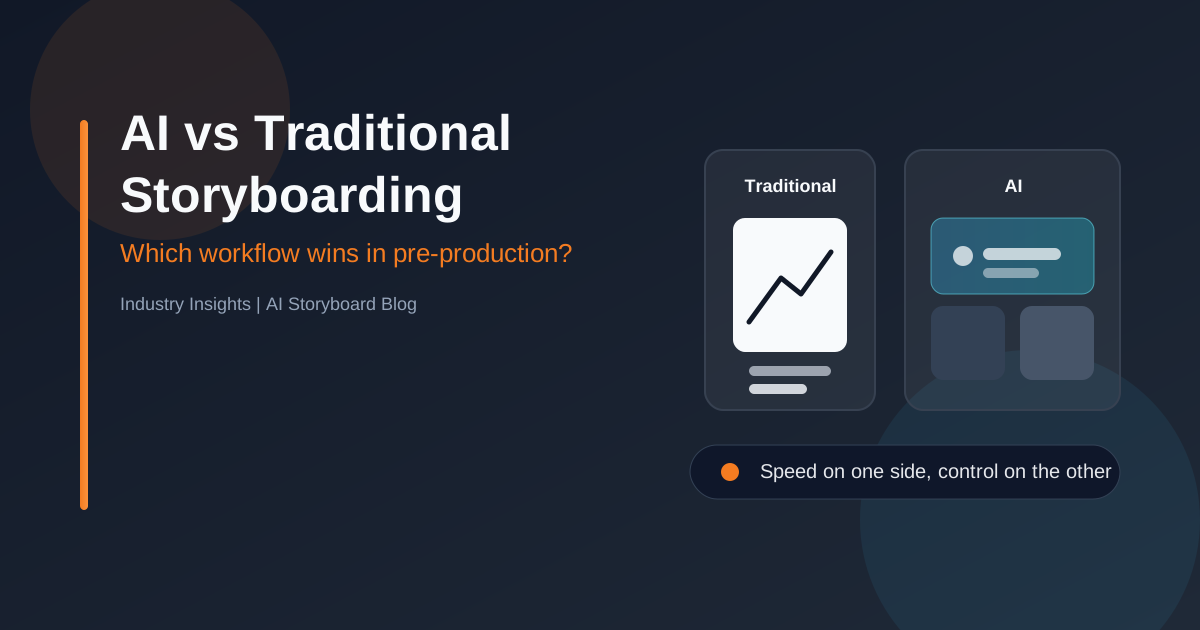
If you search for advice on storyboarding workflows, you often get one of two unhelpful answers. One side says AI replaces slow manual work. The other says real visual thinking only happens with a pen in hand. Both are too clean to be useful. A storyboard is not a philosophy exam. It is a planning document under pressure.
For teams using AI Storyboard or any similar tool, the real question is not whether AI is "better" than traditional storyboarding. It is where each method lowers risk. Good pre-production is mostly risk management: coverage risk, continuity risk, client misunderstanding, and expensive late changes.
Why This Comparison Keeps Coming Back
Traditional boards earned trust because they were direct. A director could sketch an idea, point at the frame, and everyone understood what mattered. No translation layer, no model interpretation, no prompt drift. The work might be rough, but the intention was visible.
AI storyboarding fits pre-production that needs fast concept iteration or an early visual draft. It reduces the time between a creator's hypothesis and a sequence the team can review.
Where Traditional Boards Still Win
Hand-drawn or manually assembled boards still have an edge in three places: intent, abstraction, and precision of emphasis. A quick drawing can exaggerate a blocking idea without committing to surface detail. It can say, "the actor feels trapped here," without getting distracted by costume texture or the exact wallpaper pattern.
Traditional boards also shine when the camera logic is the product. If you are designing a difficult action sequence, an effects-heavy setup, or a shot that depends on exact staging, loose drawing often moves faster than fighting a model to respect geometry.
Traditional usually wins when: camera blocking is highly specific, surface realism is not yet needed, or the director wants to communicate emotional emphasis more than finished visuals.
Where AI Gets You There Faster
AI wins on momentum. When the team needs to explore five directions before lunch, a fast generator is hard to ignore. That is especially true for pitch decks, ad concepts, short-form video planning, and early-stage client communication. You can move from script beat to visible frame before the room loses energy.
AI is also useful when the audience for the storyboard is not fluent in rough sketches. Clients, stakeholders, and non-technical collaborators often respond better to images that feel closer to the finished tone. Not because they are more correct, but because they reduce the imagination gap.
The catch is obvious: AI gives you apparent completeness very early. That can be a gift or a trap. A frame can look polished while still being structurally wrong. Speed helps only if you keep judging the board as a board, not as a pretty image.
The Real Bottleneck Is Revision
In most teams, the first draft is not the cost center. Revision is. Traditional storyboards become expensive when every new note requires redrawing multiple panels. AI becomes expensive when each revision creates continuity drift, inconsistent characters, or vague camera logic that has to be corrected by hand anyway.
That is why the better comparison is not "manual versus AI." It is "which workflow makes revisions less painful?" If the note is about mood, wardrobe options, location feel, or broad visual direction, AI often moves faster. If the note is about screen direction, lens intent, stunt geography, or choreography, traditional boards often stay more stable.
| Task | Usually Faster | Watch Out For |
|---|---|---|
| Early concept exploration | AI | Mistaking polish for clarity |
| Precise blocking and staging | Traditional | Time cost of redrawing |
| Client-facing mood boards | AI | Overpromising final look |
| Action continuity planning | Traditional or hybrid | Losing screen direction in generation |
A Hybrid Workflow That Actually Works
The workflow I trust most is boring in the best way. First, rough the sequence at the beat level: what the viewer needs to understand in each panel, where the subject is, and what the camera is doing. This can be scribbles, shot notes, or ugly thumbnails. Then use AI to test tone, framing options, and presentable variations once the logic is stable.
That order matters. If you start with AI before the sequence logic is decided, you end up negotiating with outputs instead of directing the scene. If you start with structure, AI becomes a multiplier rather than a distraction.
A simple hybrid sequence looks like this:
- Write the shot beats in plain language.
- Mark continuity anchors: character look, location, time of day, key prop.
- Sketch or outline the sequence roughly.
- Generate visual options for the panels that need presentation value.
- Manually correct the few frames where camera logic matters most.
Test the hybrid workflow quickly
Start with a tight scene description, generate options, then refine only the frames that actually need more control.
Open AI StoryboardWhen I Would Pick Each Approach
If I were building a pitch deck for a short film, pitching a branded spot, or exploring alternate moods for the same concept, I would reach for AI first. The speed of variation is the advantage, and the audience usually needs to feel the direction before they care about technical exactness.
If I were planning an action beat, a VFX sequence, or a complicated multi-camera setup, I would start traditionally or at least with rough manual boards. The point is not nostalgia. It is control. When physical space and continuity are the real problem, a simpler visual language can be more accurate.
If I were shipping under real time pressure, I would use both. That is the unromantic answer, but also the most honest one.
So Which One Wins?
AI wins the first-mile problem: getting ideas visible fast enough to react. Traditional storyboarding wins the last-mile problem: making sure the sequence still means what you think it means. Between those two points is where most of the real work lives.
AI compresses the exploratory front end of pre-production. Traditional drawing and story-artist judgment still provide control, performance choices, spatial reasoning, and deliberate simplification.