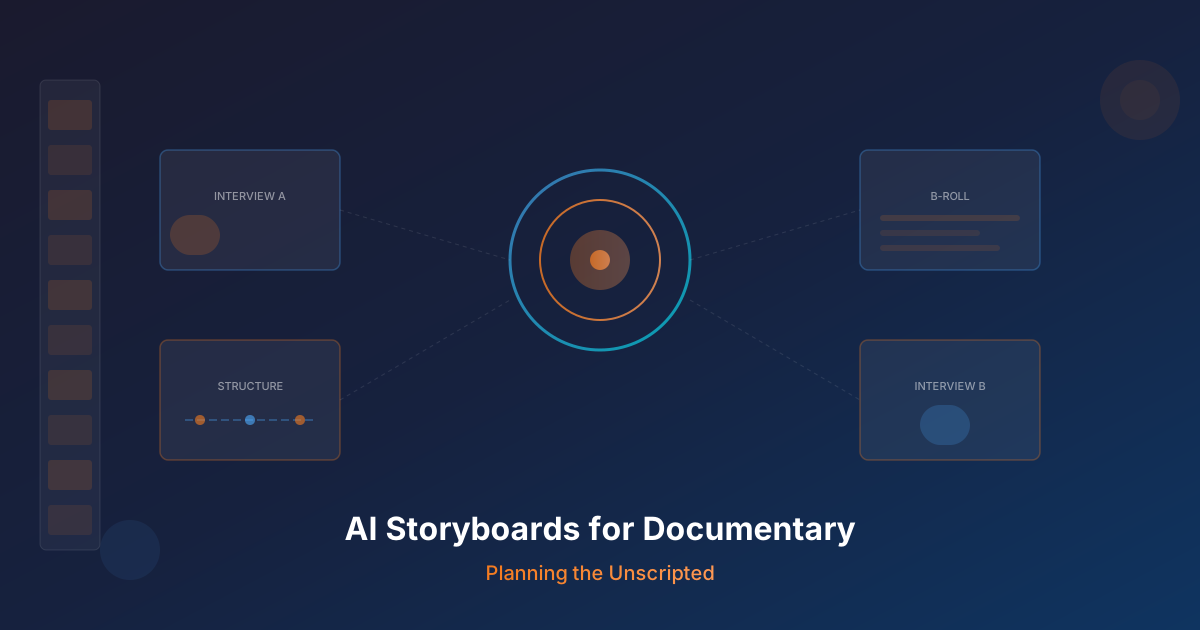
Documentary storyboards should not predict unscripted events. They can define interview framings, B-roll categories, visual motifs, and the narrative questions a crew needs to investigate. That preparation reduces the risk of returning with extensive footage but no usable throughline.
Storyboarding a documentary isn't about controlling reality. It's about having a conversation with yourself—before the plane ticket, before the rental van, before the subject sits down and says something you didn't expect—about what kind of film you think you're making. AI tools like AI Storyboard don't make that conversation easier, exactly, but they make it faster and more visual, which turns out to matter a lot.
The Paradox Nobody Talks About
Here's the thing: every documentary has a script. It just gets written after the shoot, in the edit room, often by someone who wasn't there. The "unscripted" label is a production-side truth and a post-production lie. You may not know what your subject will say, but you absolutely know what you hope they'll say, and you've already imagined the shots around those words.
That imagining is storyboarding. It's just invisible, buried inside your head where it can't be shared with the DP, can't be challenged by the producer, and can't survive first contact with a location that looks nothing like Google Street View promised.
Making the invisible visible—even roughly, even as a sequence of mood panels that might get thrown away by lunch on day one—is the entire point. It's not about being right. It's about being specific enough to be wrong in useful ways.
What Documentary Boards Actually Hold
A documentary storyboard looks nothing like a narrative one. There are no dialogue lines. No shot-reverse-shot patterns choreographed to the second. Instead, you're working with three loose containers: interview setups, B-roll sequences, and structural beats.
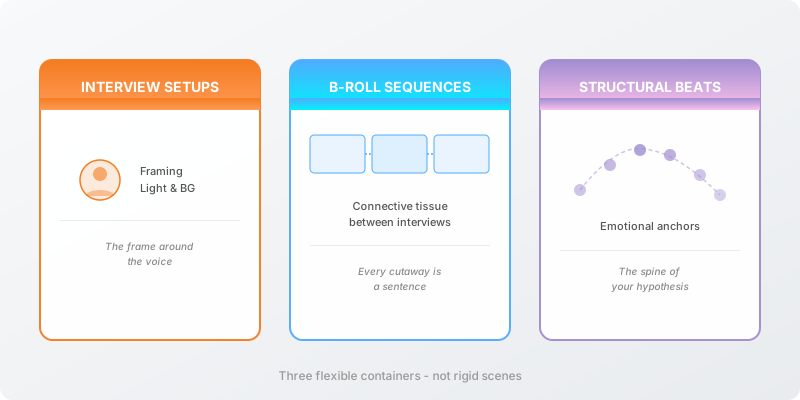
Documentary boards hold plans, not scripts—three flexible containers instead of rigid scenes
Interview setups are about the chair, the light, the background—the frame around a face that will carry your film. B-roll is the connective tissue, the shots that buy you an edit point or build a sense of place. And structural beats are the emotional anchors: the moment the farmer looks at the dry field, the activist turning away from the camera, the child running through a door.
None of these demand precision. All of them benefit from intention. A panel that says "wide shot of the factory floor, warm overhead light, workers moving left to right" is not a cage. It's a compass bearing. When you walk onto that factory floor and the light is cold and fluorescent and everyone is standing still, you'll know instantly what changed and what to do about it.
Mapping the Interview Before the Chair
I'll admit this is where I lean hardest on AI generation. Interviews are the skeleton of most documentaries, and yet the visual planning for them is often an afterthought: find a room, set up two cameras, hope the background isn't a mess.
Generate several rough framing options for each major interview before the shoot: a tight headshot against a simple background, a wider environmental frame, or a profile shaped by available window light. Each option changes what the setting communicates before the subject speaks.
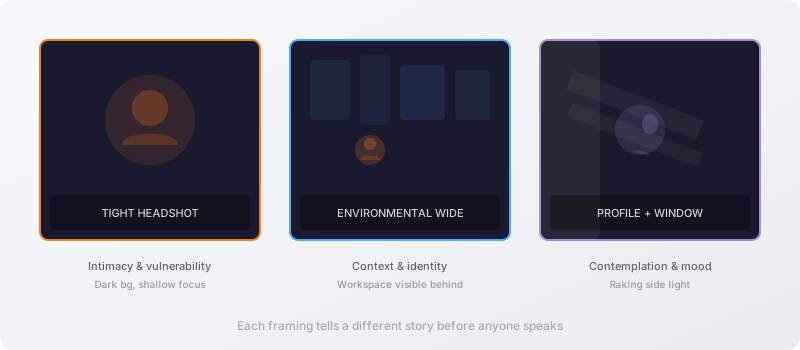
Different interview framings carry different emotional weight—decide before you arrive, not after
The key is to generate with constraints. Don't prompt "interview setup." That's too vague and the model will hand you a stock-photo nightmare. Instead: "middle-aged woman seated in a cluttered ceramics workshop, soft side light from a single window, shallow focus, eye-level camera." Specificity is respect—for the tool and for the person you're about to film.
Review the options with the cinematographer and compare them with the real location. The discussion creates a shared starting point while leaving room for available light, subject comfort, and discoveries on the day.
B-Roll Is Not Decoration
B-roll should add evidence, context, contrast, or point of view. A cutaway that only covers an edit can help the assembly, but the planned B-roll categories should also advance the film's argument.
Storyboarding B-roll means deciding, before you have footage, what those sentences should say. A board might plan a sequence: hands pulling weeds, then a wide of the irrigation ditch, then a close-up of cracked soil. That's not random beauty. That's a three-shot argument about water scarcity told without a single word.
AI generation helps here because it forces you to articulate the shot. You can't generate "some nice nature footage." You have to describe what the camera sees, where the light falls, what the frame excludes. The discipline of writing that prompt is, strangely enough, the discipline of thinking like an editor months before you sit down to edit.
The Arc You Can Plan
Write a working hypothesis for the film. For example: “A conservationist tries to save a river, then the river changes his idea of success.” Use that spine to test whether an interview setup or B-roll category advances the inquiry or belongs in a different project.
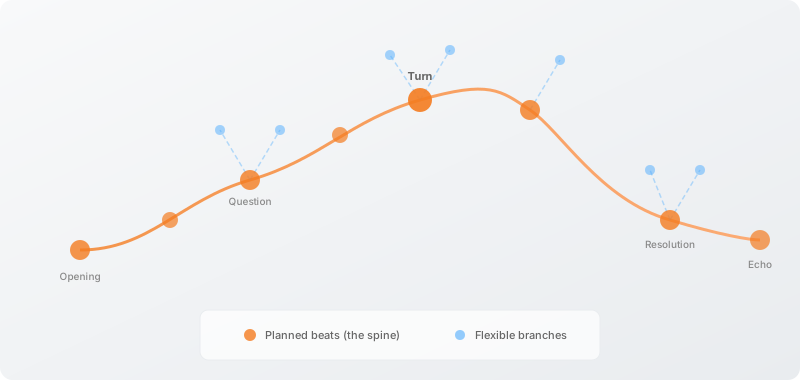
The spine holds; the branches flex—a storyboard maps both
I lay out the arc in maybe eight to twelve panels. Opening image. The world before the question. The question itself. Two or three escalations. A turn. Resolution—or its absence. This isn't a rigid beat sheet; it's closer to a musical score with blank measures where the improvisation happens.
What AI boards give me at this stage is speed. I can generate a rough visual for each beat in twenty minutes, print them on a wall, and step back. Does the sequence feel like it moves? Is there a visual motif that repeats? Does the ending echo the opening? These are editing questions you can ask—and partially answer—before you shoot a single frame.
Plan your documentary visually
Map interview setups, B-roll sequences, and narrative arcs in panels—free, no account needed.
Open AI StoryboardWhen the Field Rewrites Everything
Here's where the honesty has to live. The storyboard will be wrong. Not a little wrong—sometimes spectacularly, wonderfully wrong. Your subject cancels. The location floods. The person you thought was a side character turns out to carry the whole story.
The boards don't survive this. They're not supposed to. What survives is the thinking that made them. You know what emotional beat you were chasing. You know what visual rhythm you wanted. So when reality hands you something better—and it almost always does—you can recognize it, because you had a plan to compare it against.
Keep the board as a flexible checklist rather than a set of marching orders. Between setups, check whether the crew captured an opening image, a useful establishing view, and the B-roll categories the edit may need. Replace a planned image when the location offers stronger material.
To be honest, the best shoots are the ones where every storyboard panel gets replaced by something I couldn't have imagined. The boards didn't fail. They did their job—they kept me looking—and then reality did the rest.
The Umbrella and the Rain
Documentary filmmaking will always be a negotiation between the film you planned and the film that happened. The storyboard is not the film. It's the conversation you had with yourself about the film, made visible and shareable and, most importantly, disposable.
AI makes that conversation cheaper. Not cheap in the sense of careless—cheap in the sense that you can afford to have it more often, with more variations, and throw away what doesn't serve the story without mourning the hours spent drawing. Generate, evaluate, discard, generate again. The rhythm isn't precious. It's practical.
So yes—pack the umbrella. You might not need it. You'll almost certainly end up standing in a kind of rain you didn't expect. But you'll be standing there with a plan in your back pocket, and that plan will make you faster at noticing when the world offers you something better than what you imagined.
That's the quiet gift of preparation: not control, but recognition. The storyboard teaches your eye what to look for, so that when the unscripted moment arrives, you're already pointed in the right direction.