Two brothers stand in their father's garage, dividing the tools before the house goes on sale. Dana holds a socket wrench and keeps talking about the kitchen tiles. Theo opens the toolbox, closes it, and then says the thing about the fishing trips. The words are written. The scene will be made somewhere else.
Dialogue scenes fail in the edit more often than on the page. The lines land, the performances hold, and the sequence still feels like two recordings stapled together. That failure is drawn in advance, in coverage that never had a plan for how its pieces would meet.
Boarding dialogue is a craft with a small vocabulary. Learn the kit, draw the eyelines with intent, and place your cuts where the scene turns. Everything else is attention.
The Words Are the Easy Part
A script page tells you who says what. It withholds the two facts an editor needs most: where each speaker's power sits, and how that power moves. The same eleven lines can play as a confession, an ambush, or a negotiation, and the difference lives in frame choices that no one wrote down.
So the first board for a dialogue scene contains no frames. It contains one line, drawn across the page: who leads at the start, where the lead changes hands, and who holds it at the end. In the garage, Dana leads by filling the air. The turn arrives when Theo closes the toolbox. After that, Dana has to answer, and she has to do it on camera, in a frame that can hold her face for a while.
That one-line map earns its keep twice. It decides where your longest lenses of attention point, and it tells the editor which moments the cut must protect.
Start from the Power Line
Draw the turn first. The turn is the moment the scene's answer changes: Theo closes the toolbox, or Dana admits she is selling hers. Everything before it plays one way; everything after plays another.
Give each side of the turn its own coverage plan. Before the turn, Dana owns the screen: wider frames, room around her, Theo listening in profile at frame's edge. After the turn, the frames close down on Theo, and the first shot of Dana answering should be her longest hold in the scene. The audience reads the transfer of power through framing long before the dialogue confirms it.
A question worth writing on the board: does anyone change physical ground? If Theo crosses from the bench to the door after the turn, that walk is a free edit point and a whole new geography. Boards that track the crossing stay useful; boards that ignore it produce jump cuts in the edit.
The Basic Coverage Kit
Five frames cover most two-person dialogue scenes, and editors cut from them every day:
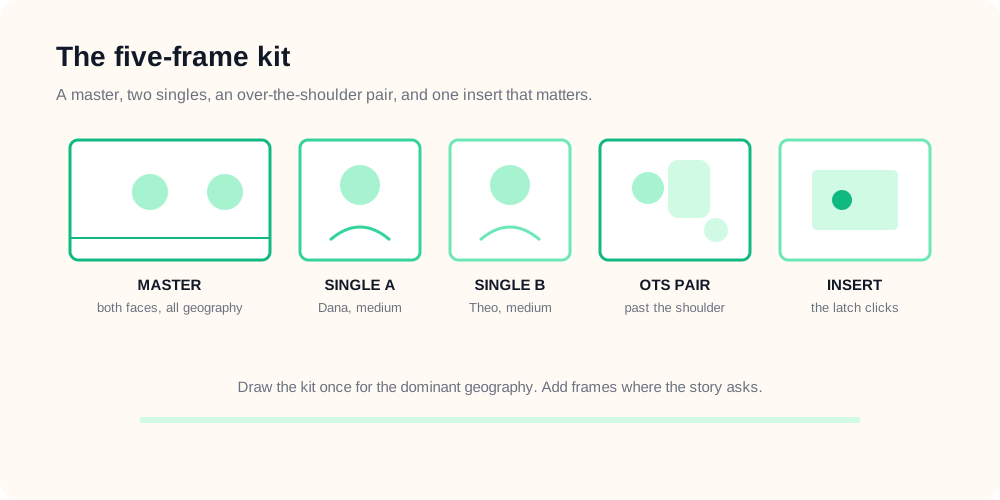
The kit: a master, two singles, an over-the-shoulder pair, and one insert that matters.
- The master: both faces, the whole geography. It sets the eyeline angles every other frame must honor, and it saves the scene when a performance blooms in an unplanned place.
- Two singles: one clean frame per speaker, at the size the scene's emotion demands. The garage wants medium singles: close enough for faces, far enough to keep the tools in frame.
- An over-the-shoulder pair: each speaker framed past the listener's shoulder. These carry confrontation and connection, and they give the editor pairs that cut at matching sizes.
- An insert: the wrench, the toolbox latch, the order slip. One insert, chosen for meaning, outperforms five cutaways chosen for safety.
Draw the kit once for the scene's dominant geography. Then add frames only where the story demands a different size or angle. The kit is a floor, and a floor is what lets you improvise without falling.
Let the Eyelines Argue
An editor can repair a lot. An eyeline mismatch survives no repair. When Dana looks frame left and Theo, in his single, looks frame left too, the audience reads two people talking to the same empty wall. The board is where you prevent that, with a diagram of the two eyeline vectors before any frame gets drawn.
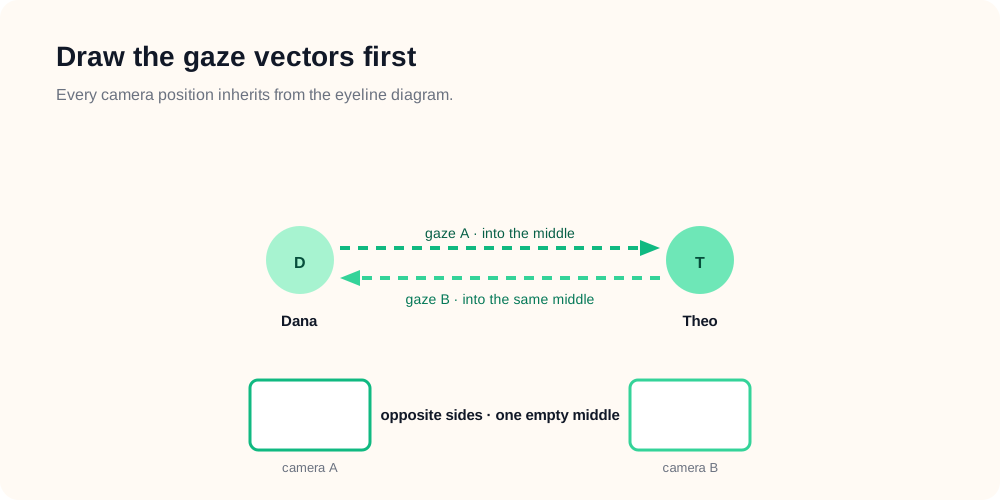
Draw the gaze vectors first. Every camera position inherits from them.
Three eyeline decisions shape the whole scene. Height: a raised chin reads as status, so Theo's eyeline lifts a hair after the turn. Distance: the more screen gap between gaze and target, the more tension the frame carries; over-the-shoulder frames read closer than singles for that reason. Direction: each speaker's gaze points into the same empty middle space, from opposite sides, and every camera position you choose has to respect it.
Boards catch another silent killer here: drifting eyelines between takes of the same frame. Note the exact gaze target beside the frame in your panel notes. "Eyes to the latch, then up" survives a reshoot. "Looks at him" does not.
Cut In on the Turn
Where the cut lands is a directing choice, and it belongs on the board. Cutting on the last syllable reads tidy. Cutting a beat before the line ends reads eager. Cutting after the line ends, onto the listener, hands the moment to a face, and faces are where audiences live.
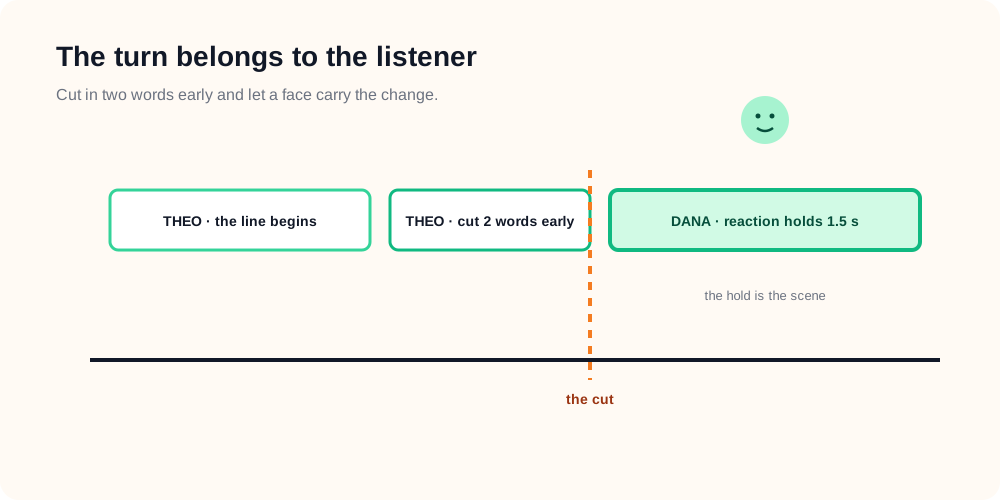
The turn belongs to the listener. Cut in early enough to hand it over.
In the garage scene, Theo's toolbox line should lose its final words to a cut. The board marks the edit two words early, onto Dana, and her reaction holds for a full second and a half of nothing. That hold is the scene. Draw the reaction frame with as much care as the speaking frames, because the edit will lean on it more.
Mark your intended cut points on the panels. Editors override them, and good ones should, but a marked preference starts the conversation at a better place than a stack of unmarked frames.
Give Them Business
Talking heads drain scenes. Hands save them. The wrench in Dana's grip gives her a prop to fidget with while she avoids the subject, and the toolbox latch gives Theo a decision to make with his fingers before his mouth catches up.
Board the business as frames, in the same kit as the dialogue. A medium single of Dana that includes the workbench lets her polish a wrench through her whole speech. An insert of the latch clicking shut can replace a line of dialogue about being done. Business carries meaning between the lines, and it buys the editor small local cuts that keep a long scene alive without a single reframing.
When you generate reference frames for the scene, fold the business into the frame description. "Dana polishing a wrench, avoiding Theo's eyeline" produces a more useful panel than "Dana talking." The prompt pitfalls guide covers how crowded descriptions backfire, and a single concrete action steers clear of that trap.
Board the conversation, not the transcript
Draw the kit, mark the turns, and give your editor frames that argue with each other.
Open AI StoryboardThe Read-Through Test
Run the finished boards against a recording of the lines, even a rough one from your phone. Panels advance with the audio, and within a minute you will feel the seams: the single that cuts back a half-second late, the reaction that arrives before the line that earns it, the insert that interrupts a sentence it has no business interrupting.
Two checks close the pass. Play the sequence with the sound off and see whether the power transfer still reads through framing alone. Then play it with your eyes closed and hear whether the cuts land where the voices breathe. A dialogue scene that passes both is ready for a crew.
The garage empties out by dusk. The wrench goes in one box, the soldering iron in the other. On screen, the scene will run three minutes, and most of what it says will travel through eyelines, a latch, and one held reaction. None of that appears in the transcript. All of it appeared in the boards, weeks earlier, drawn on purpose.


