Thirty seconds of film, one trail-shoe launch, and a conference room booked for forty-five minutes. On the screen sits your board: a runner at a trailhead in fog, a failed grip on wet rock, a re-lace, a second attempt, a summit, a line of type. The client has brought their brand manager, their media lead, and someone from legal.
What happens in that room follows patterns. The boards get admired. Then someone asks what the runner is wearing on their feet in frame one, and the meeting splits between people talking about filmmaking and people talking about risk. Half the room is now somewhere the boards cannot follow.
Presentations go better when the boards are framed as a sequence of decisions, with their consequences named. Here is the method, in the order that survives contact with a real meeting.
The Room You Are In
Start from the client's job. They will defend this buy internally, to people who never enter the room. Their approval is a bet that the finished spot will look the way the boards promise, cost what the plan says, and clear legal without surprises. Every question they ask maps to one of those three fears.
That reframes what a board review is for. The client is not judging your drawing. They are deciding whether the film in their head, the budget in their plan, and the claims on the package can coexist for thirty seconds. A presenter who speaks to those three concerns keeps the room together. A presenter who defends pen-work invites the room to redesign it.
Say this out loud at the start, in one sentence: these boards show the decisions, and we will walk through what each one buys. That sentence sets the terms for everything after it.
Present the Decision, Not the Artwork
Walk the sequence in the order the audience will see it, and for each beat name the decision it locks. The fog at the trailhead is not scenery; it is the promise of a real place, and it sets the grade for the whole spot. The failed grip is the conflict, and it exists so the re-lace can be the answer. Each beat gets one sentence of intent before anyone comments on how it looks.
This order matters because approval flows downstream. A client who accepts the beats is approving the story. A client who accepts the story has no reason to relitigate framing, because framing now serves a structure they have already bought. Skip the beat walk, and every frame becomes a fresh negotiation.
Keep a beat map on one page, visible the whole meeting. When discussion drifts to a single panel, point back to the beat it serves. Drift is natural; the map gives it a shore to return to.
One Beat Per Page
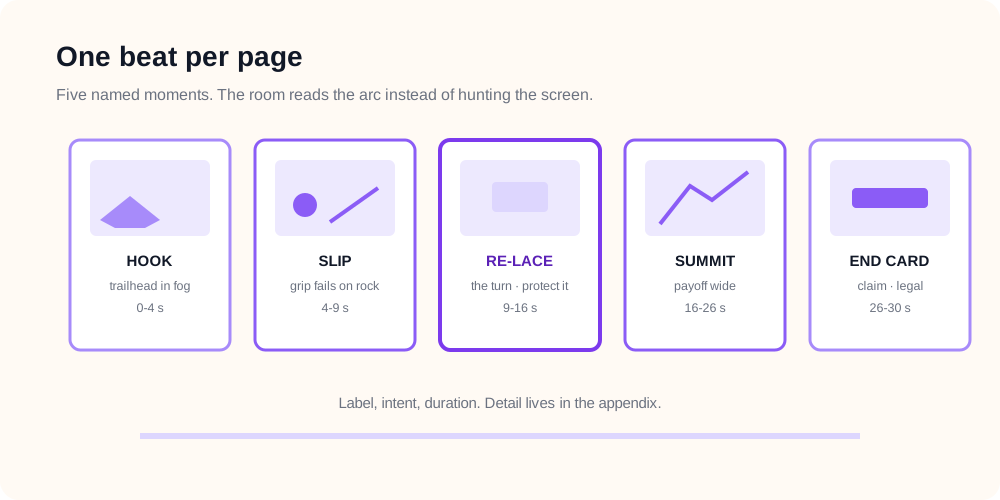
Five pages, five beats. The room reads the arc instead of hunting the screen.
Build the deck from the boards, one beat per page, with the panels for that beat grouped under a two-word label: Hook, Slip, Re-lace, Summit, End card. Under each label, one line of intent and the duration it earns. The room can hold thirty seconds of film in their heads when it arrives as five named moments.
Resist the urge to show every panel. A page carrying nine frames invites line edits on all nine. Group panels under the beat, and the conversation rises to the level where your decisions live. Detail lives in the appendix, where the producer can find it and the room can ignore it.
End the deck with the one page clients remember: the end card, the pack shot, the claim. Legal will meet it there, and it is better they meet it inside your structure than at the door.
The Three Questions That End Meetings
Certain questions arrive in every board review, and they arrive better answered:
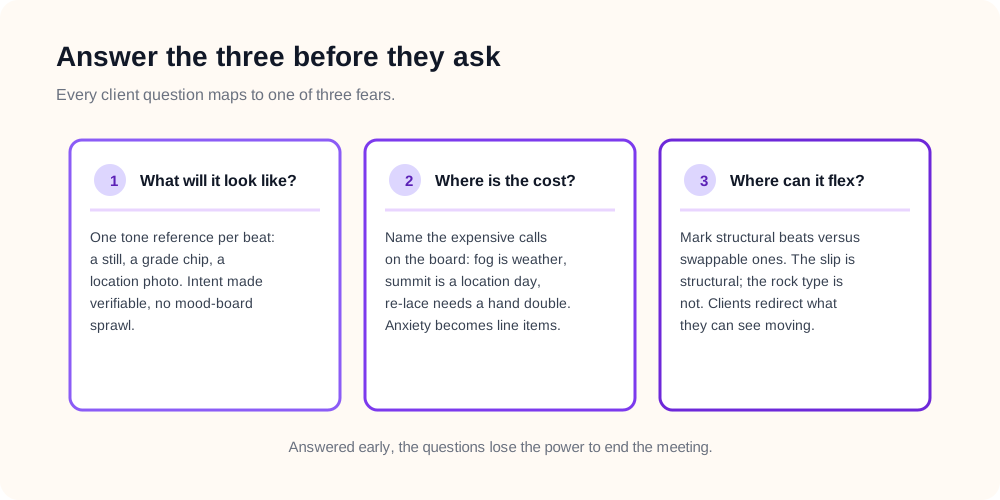
Answer the three questions before they are asked, and the room stays yours.
- What will this look like for real? Bring a tone reference per beat: a still, a grade chip, a location photo. Boards are intent; references make intent verifiable. One image per beat, no mood-board sprawl.
- Where does the cost sit? Name the two or three expensive decisions on the board out loud: the fog is a weather call, the summit is a location day, the re-lace is a close-up that needs a hand double. Naming them converts anxiety into line items the producer can speak to.
- Where can this flex? Mark, on the board pages, which beats are structural and which are swappable. The failed grip is structural; the type of rock is not. A client who knows the flex points asks for changes there, and the spot survives their changes.
That third answer deserves practice. It is the difference between a client who redirects the film and a client who trims the parts you marked as spare.
Surviving Round Three
Round one produces notes. Round two produces harmony. Round three is where boards die, because nobody tracked what the first two rounds agreed to. The fix is bookkeeping, and it takes ten minutes a round.
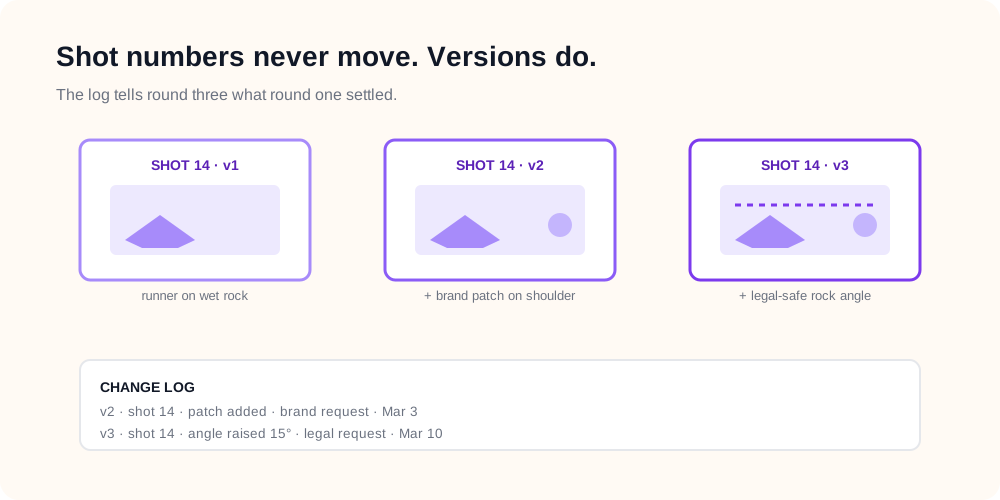
Shot numbers never move. Versions do. The log tells round three what round one settled.
Three habits carry a board through every round:
- Stable shot numbers: frame 14 stays frame 14 even when frame 14 changes clothes. Renumbered boards make notes impossible to trace and give the room permission to reopen settled deals.
- A change log beside the boards: every accepted note becomes one line: what changed, at whose request, in which version. The log is what you open when a late note contradicts an early agreement.
- Versioned exports, never overwrites: v1, v2, v3 live side by side. When someone asks what changed since the last call, you show the delta instead of describing it from memory.
An AI-assisted workspace keeps this cheap: duplicate the project per round, edit frames in place, and export the whole versioned set when the deck goes out. The storyboard maker holds the boards while the log holds the history, and neither depends on the other staying tidy.
When the Client Wants a Rewrite
Sometimes the note is structural: the client wants the summit first, or the runner gone altogether. Arguing taste against the person signing the check is a losing format. Move the conversation onto the beat map instead, where their note has consequences everyone can see.
Ask what the change is for. A client who wants the summit first may want the payoff earlier for short attention; that is a beat-order problem, and it may have a cheaper solution than re-shooting the opening, such as a flash-forward frame. Offer two versions of the affected beat, drawn, rather than one defended. Boards are cheap now, which is their whole advantage in this room.
Protect the turn by name. Every spot has one moment that makes the rest true; in this board it is the re-lace. Say plainly which beat carries the film, and let the flexibility you marked elsewhere absorb the pressure. Clients respect a presenter who can tell them where the film cannot bend, as long as the same presenter showed them where it can.
Bring boards that answer their own questions
Draft the beats, mark the flex points, and walk into the review with the film already decided.
Open AI StoryboardThe Sign-Off You Need
End every review by restating, in one breath, what approval covers: these beats, in this order, at these durations, with these open items logged. Approval that covers everything covers nothing; approval that names its edges survives the production week intact.
Then send the follow-up the same afternoon: the deck, the log, and three lines summarizing what settled. Future-you, on a 6 a.m. call at the trailhead with fog scheduled and a hand double in makeup, will read those three lines and know the film on the boards was agreed, dated, and signed for.
The runner makes the summit in the spot because a room full of people with different jobs once agreed on five named beats. The boards did not win the room by being beautiful. They won by making the decisions legible, and that part was never about the drawing.


