The last ferry leaves at 6:40. Your protagonist rounds the ticket hall at 6:37, sees the gate, and starts to run. On paper the scene reads clean: wide on the hall, cut to the gate, cut to the run, cut to the boarding. Eleven panels, and every one of them looks right.
Then someone asks the question panels cannot answer. How long does the run hold before we cut to the gate? Three seconds feels tense. Six feels like a pad. The storyboard shows the order of images; it stays silent on the order of seconds.
An animatic is the cheapest instrument that answers in seconds. You photograph the panels, lay them on a timeline, give each one a hold length, and press play. What you learn in the next ninety seconds of watching will change more shooting decisions than another week of redrawing.
Boards That Do Not Move Yet
A storyboard is a plan of images. An animatic is a plan of time. The first answers what the audience sees; the second answers what they sit through. Films have died of the second problem while passing the first with honors.
Studios have cut animatics since the days of pencil tests, for a plain reason: rhythm problems hide inside still frames. A chase that reads great panel by panel can play like a slideshow once it moves. A quiet two-shot can carry a whole scene if it holds long enough, and no storyboard review will tell you which kind you have until someone watches it run.
You do not need animation skills to build one. You need the panels you already have, a timeline, and the honesty to watch a rough thing at speed.
What an Animatic Is
Strip away the mystique. An animatic is your board, played in order, with a duration on each panel and sound underneath. No motion is required. The camera can hold. The drawings can be rough. The version that saves your schedule can look like a slideshow with a soundtrack, because that is what it is.
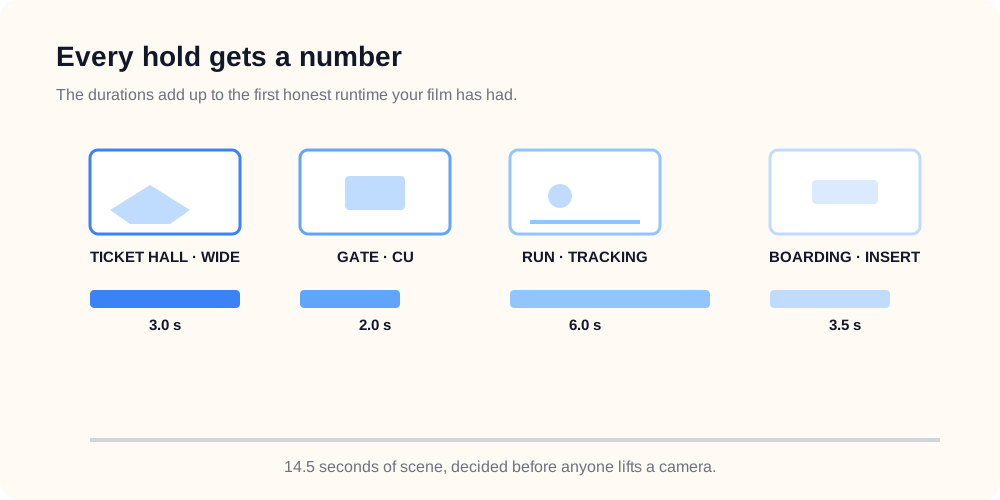
Each panel gets a hold length. The total is the first honest runtime your film has had.
Three ingredients, in the order that matters:
- Durations: a hold length on every panel, from a half second for a flash cut to ten seconds for a slow reveal.
- Sound: a scratch track, even if the temp music is the wrong song and the footsteps are claps.
- An audience of one: someone who has not read the script watches it once and says where their attention slipped.
Animation teams build elaborate versions with camera moves and temp voices. For live-action planning, that polish is optional. The value sits in duration and sound, and both cost you an afternoon.
Time Each Panel with Intent
Give every hold a reason, the way every panel has a camera job. A wide that establishes the ticket hall might hold for three seconds, because the eye needs time to walk the space. A close-up of the ferry gate might take two, since the shape reads at a glance. The running shot can hold for six if the music climbs under it, and the cut to boarding lands harder for the wait.
Two tests keep the lengths honest. First, read any on-screen text aloud at a comfortable pace, then double it; inserts live or die by reading time, and the note in her hand is no exception. Second, play the sequence with your eyes closed during the dialogue panels. If a hold feels long in the dark, it will feel longer on a screen.
Write the number on the panel. Durations belong beside the frames, where a revision can find them.
Temp Sound Changes Everything
A silent animatic lies about pace. Sound carries the viewer through holds that would feel empty without it, and sound exposes a cut that lands in the wrong place better than any frame does.
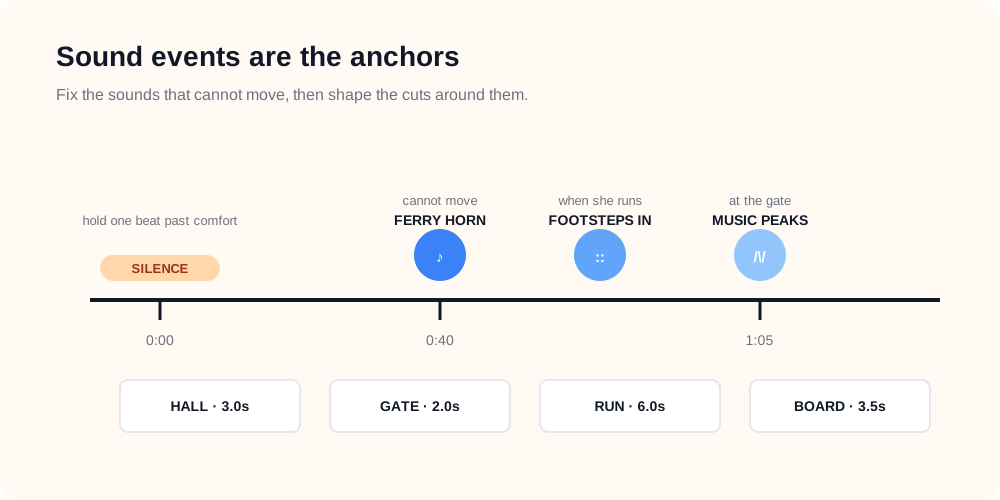
Place the sound events first, then let the panels obey them.
Work in this order: lay the events that cannot move, then shape the cuts around them. The ferry horn at 0:40 is fixed. The footsteps start when she starts to run. The music swell peaks as she reaches the gate. Once those anchors sit on the timeline, the hold lengths stop being guesses; they become the space between sounds.
Silence counts as an event. One panel with no sound at all, held a beat past comfort, does more for the panic of a missed ferry than any swell. Mark it on the timeline so a well-meant temp track does not bury it later.
Find the Dead Frames
Now watch the thing through, once, at full length. Somewhere around the middle your attention will snag. Note the exact panel where it happens, then run the three diagnoses:
- The hold drags: the drawing earns two seconds and wears four. Trim it and watch the sequence snap into place.
- Two panels repeat a beat: the run has a mid-shot and a close version that say the same thing. Merge them; the surviving frame plays faster because it stops explaining.
- The beat arrives late: the gate appears a full second after the audience has guessed it. Cut earlier. The viewer feels fast when the film trusts them.
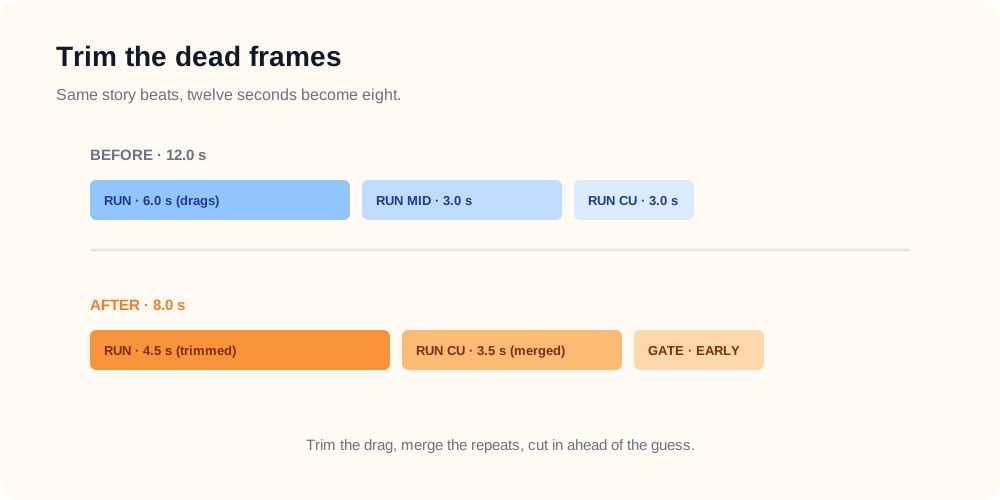
Twelve seconds become eight without losing a story beat.
Run this pass twice, not ten times. An animatic is a decision tool, and a decision tool stops paying once it turns into a hobby. Make the trims, re-watch, and move on. If a deeper structural doubt survives two passes, that is a writing problem wearing a timing costume, and the boards deserve the fix rather than the timeline.
From Animatic to Shot List
The durations you settled are production data now. A three-second wide is a setup; a six-second run with a dolly is a different kind of day. Carry each duration into the shot list beside its shot, and the schedule starts to write itself: the trim that saved four seconds of screen time saved a setup, and setups are what the day is made of.
This is where the workflow joins the rest of the pipeline. The scene description to shot list guide covers the row-by-row fields, and the shot list generator turns your timed beats into rows an assistant director can order. For the frames themselves, the video generation guide explains how a panel can become a short motion reference, which is one step past an animatic and useful for shots you are unsure about.
Hear your film before you shoot it
Draft the boards, time the holds, and let the rhythm make the expensive decisions early.
Open AI StoryboardScreen It for One Person
Find one viewer who owes you nothing. Hand them headphones, play the animatic once, and watch their face rather than the screen. Where they glance away, the film does too. Where they lean in, you have a beat worth protecting when the schedule comes for it.
Ask for two answers, in this order: where did you drift, and which moment do you remember? The first gives you the next trim. The second tells you which hold to defend when someone proposes shortening the day by forty-five seconds.
The ferry leaves at 6:40 in the animatic, the same as it will on the day. The difference is that by now, you have watched someone miss it, checked your pulse at the exact second the gate closes, and trimmed three seconds of running that nobody needed. On the shoot, when the light goes gold and the clock runs short, you will know which panel to give up. That knowledge came from the cheapest screening your film will ever have.


