The bakery closes at nine. By nine-twenty, Mara has stacked the chairs, wiped the counters, and turned the sign. Then she finds the order slip taped to the oven handle: a wedding cake, due at noon tomorrow, unstarted.
Suppose her night becomes a short film. Two documents come up fast in pre-production, and people trade their names as if they meant the same thing. Hand the wrong one across the table and the meeting goes sideways in a familiar way: the producer asks how long each setup takes, and you are showing them drawings.
A storyboard and a shot list answer separate questions. The board shows what the audience sees, and in what order. The list organizes what the crew builds, and in what order, with whom, for how long. Knowing which document serves which question is the whole game.
Two Documents, One Night
Take Mara's scene. Somewhere in it, she pulls flour off the shelf, reads the recipe twice, and laughs at a note a friend left in the cookbook. A director planning this scene makes two kinds of decisions at once, and they fight for the same hour of attention.
The first kind is visual. Where does the camera sit when she reads the note? Does the audience see the cake box before she does? The second kind is logistical. The oven scene and the phone call both need the same actress, the same corner of the kitchen, and a lighting change. Which one gets shot first so the crew can strike that rig and go home?
Storyboarders have wrestled with the first kind since studios drew panels on paper for animation timelines. Shot lists grew out of the second kind, from assistant directors who needed to sequence a day around actors, locations, and light. Neither document replaced the other. They grew up answering different bosses.
What a Storyboard Answers
A storyboard is the film in miniature. Panel by panel, it commits to a point of view: this is a wide shot, this is her hands on the bowl, this is the note held close enough to read. It decides what the audience learns and when they learn it.
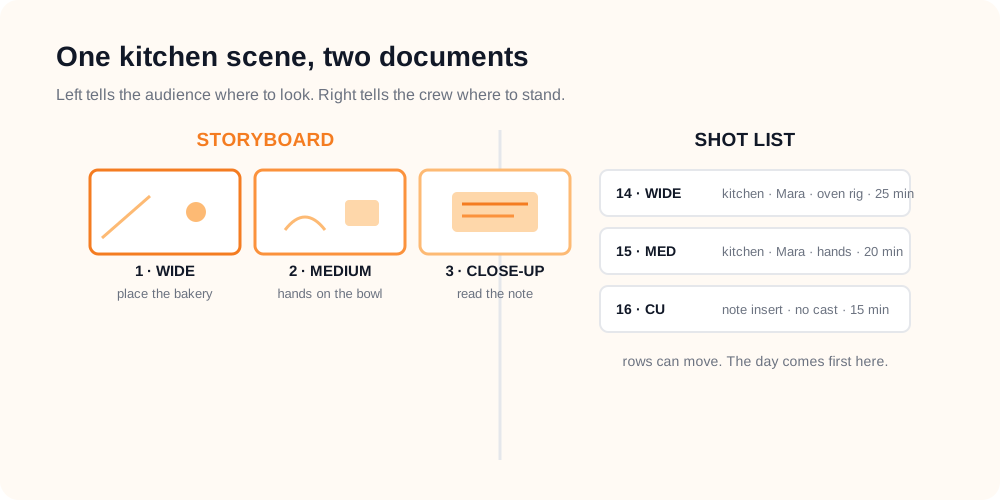
The same scene, described for the eye on the left and for the schedule on the right.
Three jobs belong to the board:
- Sequence: the order in which images reach the audience, which is the order they will experience.
- Framing: shot size, angle, and the move, if there is one.
- Emphasis: which detail earns a close-up and which stays in the background of a wide.
Notice who lives in this document. The director uses it to test the telling before anyone spends money. The cinematographer reads it for intent, then argues lenses. An editor can cut a temp version from it. In advertising, the client approves feeling and pace from it, months before a set exists. If a document needs to communicate what the finished thing will feel like, the board is the one that does it.
What a Shot List Answers
A shot list is a production instrument. Each row describes one setup: a number that survives revisions, a framing, the cast in frame, the location, the gear, and an estimate of how long the setup will hold the schedule hostage.
Where the board flows left to right like the film will, the list gets sorted by the day. Rows move. The two oven shots join the phone call because they share a corner of the kitchen and a lighting state. The note close-up migrates to a second unit or a pickup day because the actress leaves at three.
Three questions the list exists to answer:
- Coverage completeness: for each beat in the scene, which setup captures it, and did we miss one?
- Setup economy: which shots share a position, so the rig moves once and the day survives?
- Accountability: when the wrap time moves up an hour, which rows die first? The list makes that conversation concrete.
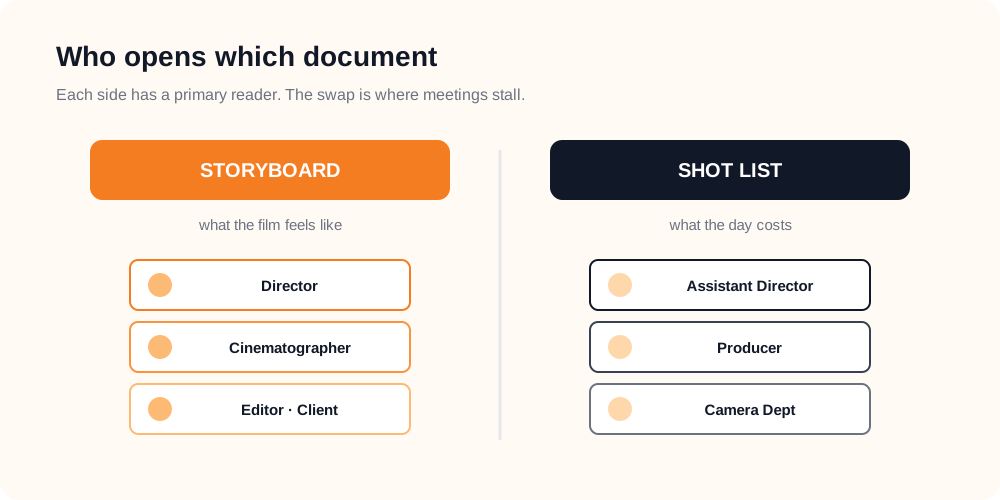
Each document has a primary reader. Trouble starts when they swap.
Where the Confusion Starts
On paper the two documents look like cousins. Both number their shots. Both name framings. On a small project they can share a page, and that is fine. A solo creator who draws six panels and scribbles lens notes beside them has made a hybrid, and it works.
Problems arrive with a crew, and they arrive through the handoff. "Shot 14" means a composition to the director and a cost to the assistant director. Give the editor your list and they receive names without images. Give the AD your boards and they receive a film they cannot schedule, because the panels carry no time, no cast list, and no order of work.
The trap has a signature: a team polishes one document while the other sits at zero, then discovers on the day that the crew needed both. The fix is cheap if you catch it in pre-production. Ask which conversations are happening this week. If people are debating feel and order, feed the board. If they are debating hours and rentals, feed the list.
Which One You Need First
Start from the decisions pending in front of you, not from a rule that ranks the documents.
Working alone
If you write, shoot, and cut by yourself, the board is your think tank. It is where you discover that Mara should find the note before the cake box, and that the scene lands better if the phone call never happens on screen. Your shot list can stay in your head until the shoot day approaches, because you are also the person who would have read it. Draw the sequence, watch it in your mind, and keep lens notes in the margins as they occur to you.
Working with a crew
With other people's time on the line, the list comes first more often than you would guess. Scheduling drives money, and money drives how much film you get to make. A rough list can exist before a single panel does: enough rows to count setups, estimate hours, and book the kitchen for one night instead of two. Boards then refine each setup in the order the day will consume them. The storyboard fundamentals guide pairs well with this stage if the sequence itself is still unsettled.
Moving Between Them Without Doing the Work Twice
The two documents share a spine. Every panel has a matching row somewhere, and the fastest workflows keep them attached.
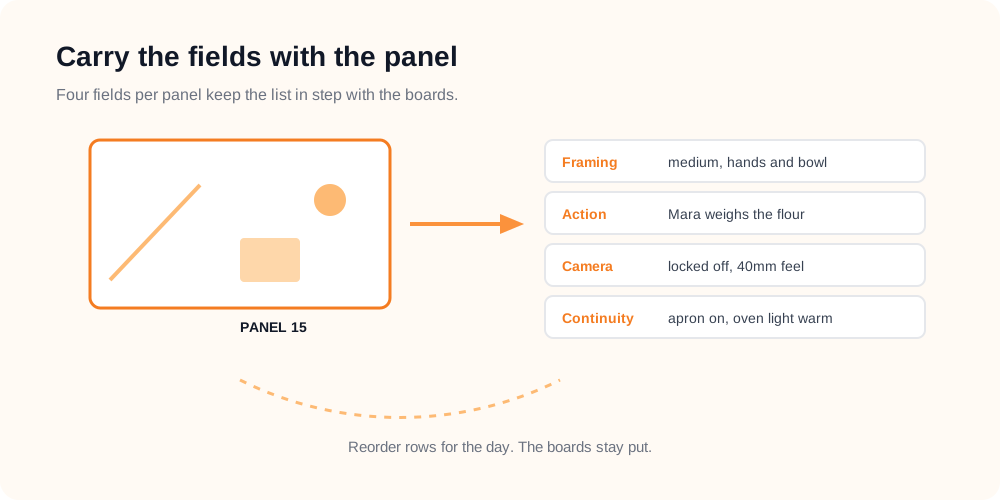
Give each panel its production fields, and the two documents stay in step.
Attach a small set of fields to each panel as you draw: framing, action in one sentence, camera intention, and the continuity note that has to survive the cut. That is enough for the list to generate itself, with rows in the order the audience will meet them. Later you reorder rows for the day and the boards stay put; the attachment means nobody re-describes anything.
This is also where an AI-assisted workspace earns its keep. Describe the scene once, get draft panels, and edit the wording before you commit to frames, the way the scene description to shot list workflow lays out. When the frames look close, the shot list generator turns the same beats into rows you can hand to an AD, and the storyboard maker keeps the panels open for edits while the schedule shifts underneath them.
Keep both documents in step
Draft the boards, carry the fields, and hand your crew a day they can run.
Open AI StoryboardA Test Before Your Next Shoot
Two questions close the loop. Hand your boards to someone who has never read the script. Can they retell the scene, in order, with a pause in the right place? Then hand your list to whoever runs the day. Can they build a schedule from it without calling you three times?
Whichever question fails tells you which document needs another pass. The board is failing when people ask what happens next. The list is failing when people ask how long things take.
Back at the bakery, the cake comes out of the oven at six. The crew call is at seven. Between those two facts sit two documents that did their separate jobs: the boards told everyone what the morning should look like, and the list told them when to be ready for each part of it. Mara, at last, gets to think about the cake.


