Two kids trade a baseball card across a kitchen table. Nadia slides the card left to right. Omar takes it and looks at it. Twenty frames will cover the exchange, and one rule decides whether the scene plays or wobbles: once the cameras choose a side of that table, every camera stays on that side.
Nobody in the audience will name the rule. They will feel its absence. A character who faces left in one shot and right in the next, with no move between, reads as teleporting. The scene stops being a place and becomes a series of pictures.
Screen direction is a spatial contract with the viewer, and boards are where the contract gets written. Here is how to draw it so it holds.
The Rule Nobody Notices Until It Breaks
Call it the axis, the line, or the 180-degree rule; the mechanics stay the same. Between two people sits an imaginary line. Cameras may sit anywhere on one side of it, inside a half circle that spans 180 degrees. Cross to the other side mid-scene, and the characters trade screen positions for no reason the viewer can see.
The rule exists because of how humans map space. We build a mental model of a scene from the first frames: who stands where, which way the world extends. Each cut updates the model, and the update only works when positions stay stable. Break the contract and the model rebuilds at the worst moment, mid-conversation, when attention should be on faces.
Boards carry the burden of catching this before a crew does. A drawn panel shows faces, but it hides the camera's relationship to the room. The fix is a second drawing, one most beginners skip: the map.
One Line, One Side
Before drawing a single panel of the card trade, sketch the kitchen from above. Nadia sits west, Omar sits east, and a dashed line runs north to south between them. Every camera position you plan lives in the half circle south of that line. From there, Nadia always faces frame right and Omar always faces frame left, in wide shots, singles, and close-ups alike.
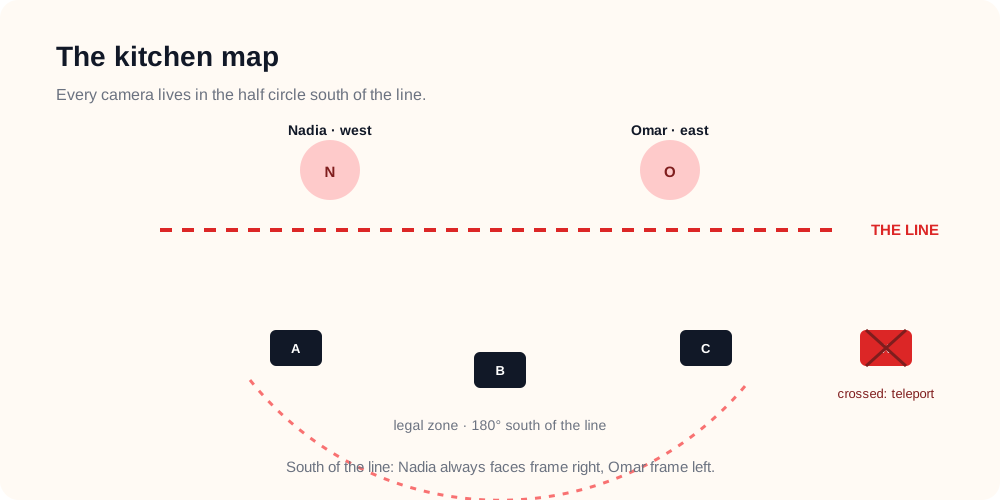
The half circle is the legal zone. The crossed camera is the teleport machine.
Attach the map to the board set. Every panel inherits its screen direction from that one page, which means every question a crew asks later has a written answer. Where was the camera? South of the line, position C. Why does she look frame right? Because Omar is east. The map turns taste into geography, and geography survives a producer's Tuesday afternoon questions better than taste does.
The same map governs the eyeline heights and the axis of any object that passes between them. The card travels west to east; cameras south of the line see it move left to right. All of it falls out of one diagram.
Direction Has Meaning
Screen direction is more than a consistency chore. Movement across the frame reads as narrative motion in most audiences' expectations: left to right feels like advance, right to left feels like return. The pull is cultural and soft, and it is real enough to plan around.
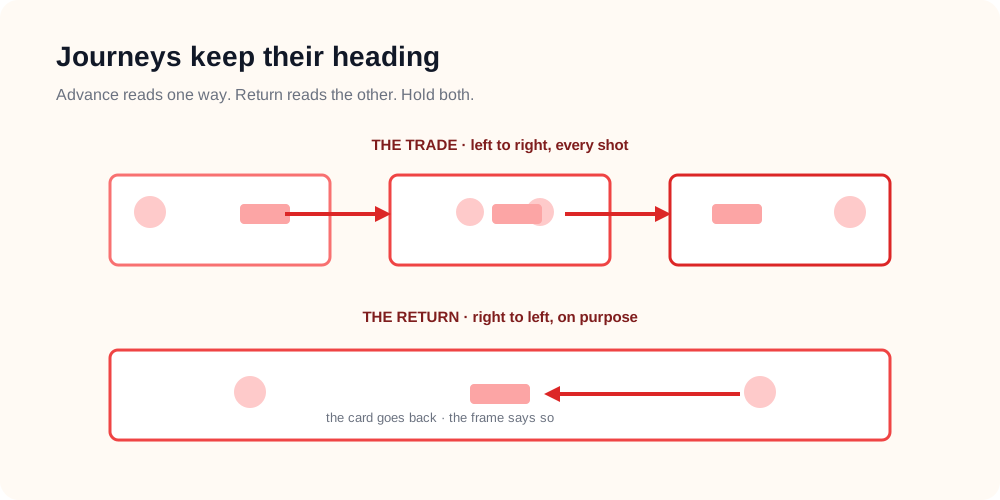
Keep a journey moving one way across panels, and the audience reads it without effort.
Use it at two scales. Within a scene, keep each journey moving one way: the card travels left to right in every shot of the exchange, so the handoff reads as one continuous act. Across a film, give each recurring journey a direction and hold it; a courier who always moves left to right toward the depot builds a direction the audience learns, and the day she travels the other way lands as an event.
When a reverse direction is the point, stage it so. The card coming back across the table should move right to left, in a frame that makes the return legible. Direction, held and then broken on purpose, becomes a storytelling tool instead of an accident.
Crossing the Line on Purpose
Sometimes the scene needs the other side: a reunion, a reversal, a fight that changes shape. Three crossings are legal, and each one tells the audience the ground has moved.
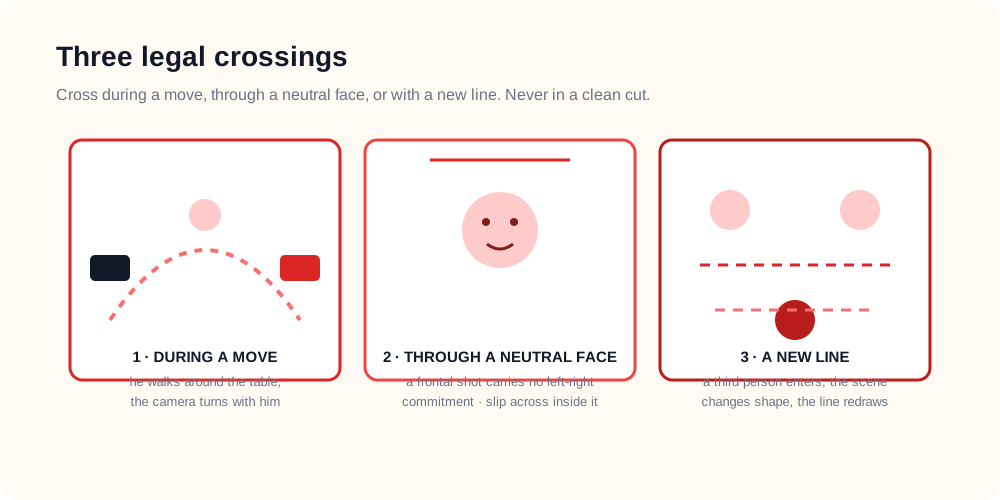
Cross during a move, through a neutral face, or with a brand-new line. Never in a clean cut.
- Cross during a visible move: the camera follows Omar as he walks around the table, and the axis turns with him. The audience saw the journey, so the new side reads as travel, not teleporting.
- Cut through a neutral shot: a frontal frame, face on to the camera, carries no left-right commitment. Slipping across the line inside a neutral shot hides the seam.
- Redraw the line with a new action: a third character enters, or the scene changes location, and a fresh line establishes itself. New scene, new map.
What stays illegal is the quiet version: two matched shots on opposite sides with nothing between them. Boards catch this with almost no effort, because the map page makes the crossing visible at planning time, when the fix costs a pencil stroke instead of a reshoot.
Movement Through Doors and Markets
The axis rule scales up to whole journeys, and journeys are where boards earn their keep on set. A courier crossing a market, a kid chasing a stolen card down a hallway: each cut between positions has to preserve the direction of travel, or the run starts looping back on itself.
The working habit is a route map beside the boards. Draw the path once, west to east, and mark every planned camera position on the same side of the route. An exit through frame right should pair with an entry through frame left in the next space, because the person kept traveling the same way. A doorway is a cut point where direction either carries or dies; board the exit and the entry as a pair, and never decide them separately.
Time of day and set dressing obey the same contract. A runner passing the same fruit stall twice must pass it in the same relative direction, or the market rearranges itself between cuts. Boards that note the stall's position keep the continuity department from inventing an answer on the day.
Drawing It into the Boards
Three marks on each panel carry the whole system:
- A direction arrow: a small arrow in the panel corner showing which way the action moves across the frame. The arrows should agree down the whole sequence.
- The camera letter: the position from the map, written under the panel number. Position C means something once the map exists.
- The eyeline note: one line on where the eyes aim, so a reshoot can match a frame drawn three weeks earlier.
When frames come from an AI generator, screen direction lives in the prompt's camera language. Describe the position relative to the map, the way the prompt pitfalls guide describes anchoring a character: "camera south of the table, Nadia frame left facing right" produces a panel that obeys the diagram. A prompt with no spatial anchor produces a beautiful frame that may belong to some other scene's map, and you will find out in the edit. The dialogue coverage guide shows the same principle applied to conversation scenes.
Give every frame a place on the map
Draw the axis, letter the cameras, and let the boards hold the spatial contract.
Open AI StoryboardThe Flip Test
The check takes five minutes and catches everything. Lay the boards in order and flip through them fast, following one character's face. Track the nose. If the nose swaps sides of the screen between any two cuts, stop and check the map: either a crossing went unmarked, or a panel was drawn from the wrong side.
Then flip through again, following the moving object. The card, the courier, the stolen bike. Its arrow should point the same way across every panel it touches, until a legal crossing changes the world on purpose.
Omar gets the card in the end. Nadia watches him slide it into a plastic sleeve, and the whole exchange plays without a single viewer thinking about cameras, which is the point. The audience gets a table that holds still in their minds. The crew gets a map that answered its questions in pre-production. Both gifts come from the same dashed line, drawn on a page nobody applauds.


